Most businesses don’t have a lead problem. They have a qualification problem.
Leads arrive. Some are ready to buy. Some are just browsing. Some will never be a fit. But without a way to tell them apart, every enquiry gets treated the same—and the hot ones go cold while you’re replying to tyre kickers.
The fix isn’t a CRM. It’s a qualification system.
Here are five steps that work for almost any business—no enterprise software required.
Step 1: Choose a Qualification Framework
A framework gives you consistent criteria. Instead of guessing whether a lead is worth pursuing, you measure it against the same standard every time.
Here are three that work well for small and mid-sized businesses:
BANT (for simplicity)
- Budget — Do they have the financial capacity?
- Authority — Are they a decision-maker?
- Need — Does your product solve a real problem for them?
- Timeline — Are they looking to buy soon?
BANT is quick, memorable, and covers the essentials. Perfect for teams just starting out.
ChAMP (for thoroughness)
- Challenges — What problem are they trying to solve?
- Authority — Who makes the purchasing decision?
- Money — Is there budget available?
- Priority — How urgent is solving this for them?
MEDDICC (for larger deals)
A deeper framework used in enterprise sales. It covers metrics, economic buyers, decision criteria, decision process, identified pain, champion, and competition. Overkill for most small businesses—but worth knowing if you’re selling higher-ticket services.
My recommendation: Start with BANT. Add complexity only if you need it.
Step 2: Set a Benchmark
Once you’ve chosen your framework, define what a “good” lead looks like for your business.
The simplest way: look at your best customers.
- What do they have in common?
- What did they say when they first enquired?
- What made them a good fit?
From that, build an Ideal Customer Profile (ICP)—a rough picture of the lead who will get the most value from what you offer.
For example, if your best customers typically have a budget of £5,000–£10,000 and need a solution within a month, that becomes your benchmark. Every new lead gets measured against it.
Step 3: Capture Intent, Not Just Data
Here’s where most businesses go wrong.
Their forms ask generic questions: “Name, email, message.” That tells you nothing about whether the lead is ready to buy.
The better approach: ask questions that reveal intent.
- “Where are you in your buying process?” (Ready to buy / Comparing options / Researching / Just curious)
- “What’s your timeline?” (Immediately / This month / This quarter / No rush)
- “What’s your approximate budget?” (If relevant to your service)
These questions do two things: they filter out tyre kickers, and they give you the exact information you need to prioritise.
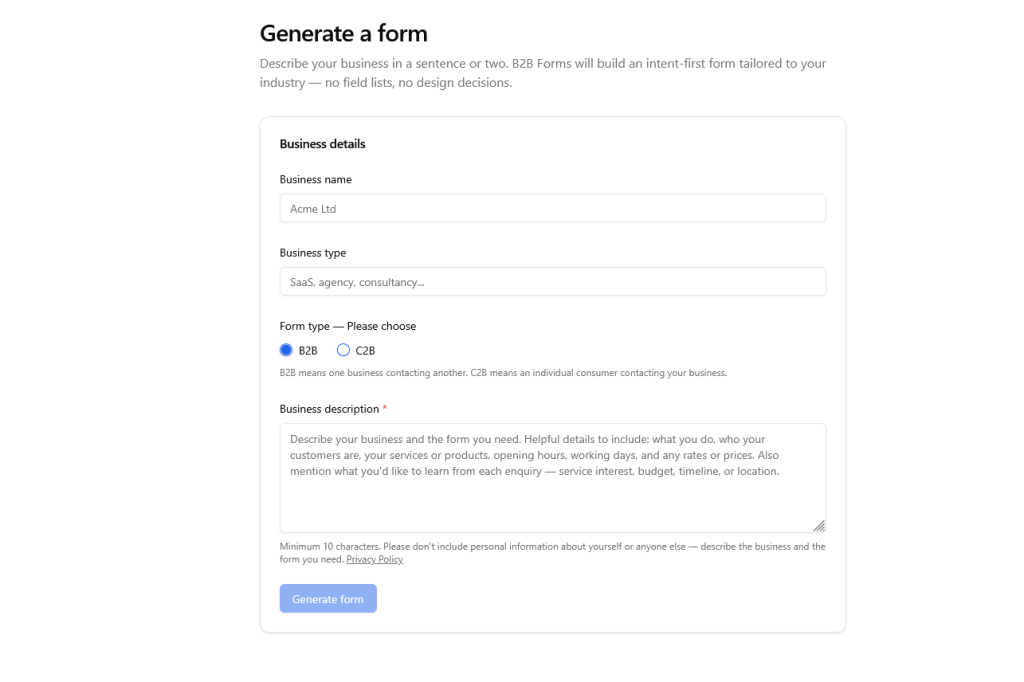
This is why I built B2B Forms—forms that create intent, not just collect data. Industry-aware, GDPR-compliant, and designed to reveal where a buyer actually is in their journey.
Step 4: Score the Leads
Now you have the information. The next step is turning it into a number you can act on.
Assign points to each qualification signal:
- Budget mentioned — 20 points
- Timeline within 30 days — 20 points
- Decision-maker — 15 points
- Clear problem described — 15 points
- Full contact details — 10 points
- High-intent source — 10 points
Add them up. Higher scores mean higher priority.
This is what LeadPath does automatically—scoring every inbound lead the moment it arrives, based on rules you control. No black box. You see exactly why a lead scored what it did.
B2B Forms captures the intent. LeadPath scores it. Together they turn a messy inbox into a prioritised pipeline.
Step 5: Prioritise and Act
Once leads are scored, group them:
- High priority (80-100) — Call within the hour. These are your best opportunities.
- Medium priority (50-79) — Follow up within 24 hours. They need nurturing.
- Low priority (below 50) — Add to a long-term nurture sequence. Not ready yet.
The key isn’t scoring perfectly. It’s being consistent. Every lead goes through the same process. Every decision is based on the same rules.
Why This Works Without a CRM
You don’t need a full CRM to qualify leads. You need:
- A framework for what “qualified” means
- A form that captures intent, not just data
- A scoring system that tells you which leads to chase
That’s it. The tools help. The process is what matters.
If you’re tired of guessing which leads matter, start with Step 1. Choose a framework. Then build a form that captures the signals you need.
Forms That Create Intent
Most forms collect data. They ask for a name and email, and hope the enquiry is worth your time. B2B Forms asks the questions that actually matter—where the buyer is in their process, what they need, and when they need it.
Industry-aware, GDPR-compliant, and ready in minutes. Free tier available, no credit card required.
Try B2B Forms Free